Your dog knows more about you from one sniff than most humans learn in an hour. That’s not hyperbole. A dog’s nose contains up to 300 million olfactory receptors — compared to about 6 million in a human. The part of their brain devoted to analyzing smells is 40 times larger than yours. When your dog sniffs your leg, your breath, or the couch after you leave, they aren’t just curious. They’re reading a detailed report on your emotional state, health, recent activities, and even your future plans.
This article breaks down exactly what your dog detects through scent, how they do it, and what that means for your relationship. No fluff, no lifestyle padding — just the science and practical takeaways.
How Your Dog’s Nose Actually Works
Dogs don’t smell the way we do. They smell in layers, like separating individual instruments in a symphony. While you catch a vague “coffee” scent, your dog identifies the roast level, the origin of the beans, whether you added cream, and what you ate for breakfast two hours ago.
Here’s the mechanism: when a dog inhales, air flows through two separate pathways in the nose. One path handles breathing. The other routes air directly to the olfactory epithelium — that’s the scent-processing tissue. This means a dog can sniff continuously for minutes without interrupting their breathing. You can’t do that. Try it.
Dogs also have a specialized organ called the vomeronasal organ (Jacobson’s organ) located in the roof of their mouth. This detects pheromones — chemical signals that carry information about identity, mood, and reproductive status. When a dog licks or chatters their teeth after sniffing, they’re transferring scent molecules to this organ for deeper analysis.
What Makes a Dog’s Nose Different from a Human’s
Three key differences explain why dogs outperform us by orders of magnitude:
- Receptor count: Humans have ~6 million olfactory receptors. A Beagle has 225 million. A Bloodhound has 300 million. That’s a 50x advantage.
- Brain allocation: The olfactory bulb in a dog’s brain is proportionally 40 times larger than in humans. Scent processing is their primary cognitive function.
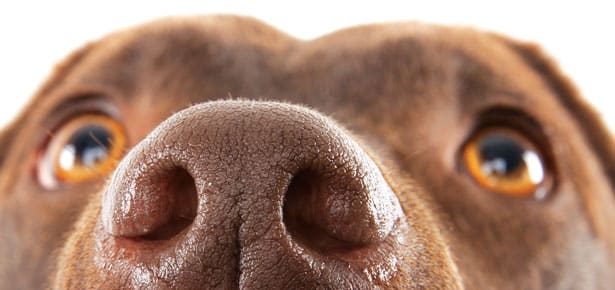
- Moisture layer: A dog’s nose is wet. That moisture traps scent particles from the air. When they lick their nose, they bring those particles to the olfactory receptors. A dry nose reduces scenting ability significantly.
Bottom line: Your dog experiences the world primarily through smell, not sight. When you walk into a room, they don’t see you first — they smell you. That’s why they sometimes react before they see you. They already know who you are, how you’re feeling, and where you’ve been.
Your Dog Can Smell Your Emotions
This is the one most people notice but don’t fully understand. Your dog knows when you’re anxious, angry, or sad — before you show it visibly.
Research from 2017 at the University of Naples showed that dogs can distinguish between happy, fearful, and angry human odors. Participants watched emotionally charged videos while researchers collected sweat samples. Dogs were then exposed to those samples. Their heart rates and behavior changed depending on which emotion they smelled. Fear sweat made them show signs of stress. Happy sweat made them more relaxed and social toward strangers.
Here’s what’s happening biochemically: when you experience an emotion, your body releases specific volatile organic compounds through your sweat and breath. Adrenaline and cortisol (stress hormones) have distinct molecular structures. So do endorphins (pleasure) and oxytocin (bonding). Your dog’s nose detects these compounds at concentrations as low as one part per trillion. That’s like detecting a single drop of blood in an Olympic-sized swimming pool.
Your dog doesn’t just smell that you’re stressed. They smell the intensity of that stress. A mildly annoyed dog owner smells different from one having a panic attack. Dogs adjust their behavior accordingly — moving closer for comfort, backing away, or becoming alert themselves.
Practical takeaway: If your dog acts anxious or clingy when you’re stressed, they’re not sensing your mood through body language alone. They’re smelling the chemical signature of your anxiety. Deep breathing before interacting with your dog can literally change your scent profile and calm them down.
Health Changes Your Dog Detects Before You Do
Dogs can smell disease. Not in a vague, mystical way — in a concrete, biochemical way. Cancer, diabetes, seizures, and infections all produce specific volatile organic compounds that dogs can be trained to identify.
A 2019 study published in Scientific Reports trained dogs to detect lung cancer from human breath samples with 97% accuracy. Another study showed dogs could identify diabetic hypoglycemia (dangerously low blood sugar) from sweat samples. The dogs detected the change in isoprene levels — a compound that rises when blood sugar drops — before the human felt any symptoms.
Here’s a breakdown of what dogs can smell related to health:
| Condition | What Dogs Detect | Reported Accuracy (trained dogs) |
|---|---|---|
| Breast cancer | Volatile organic compounds in breath | 88-99% |
| Lung cancer | Specific aldehydes and ketones in breath | 90-97% |
| Diabetic hypoglycemia | Isoprene levels in sweat | 80-90% |
| Epileptic seizures | Pre-seizure scent changes (mechanism still studied) | Variable, some dogs alert 30-60 min before |
| COVID-19 | Volatile compounds in sweat and breath | 94% in controlled trials (2026 study) |
Most dogs won’t spontaneously alert you to cancer — they need training to signal a specific scent. But many owners report their dog sniffing repeatedly at a specific spot on their body, only for a lump or mole to be diagnosed later. If your dog obsessively sniffs one area of your body for days, pay attention. It might be nothing. But it might be something your nose can’t detect.
Failure mode to avoid: Don’t assume your dog is a medical diagnostic tool. They can miss things, and false alarms happen. But if your dog’s behavior changes suddenly and persistently around you or a family member, it’s worth mentioning to a doctor. Free information that costs nothing to check.
What Your Dog Knows About Your Day (and Your Habits)
When you come home from work, your dog greets you at the door. But they already know where you’ve been, who you talked to, what you ate, and whether you stopped at a friend’s house.
Every person, place, and object has a unique scent profile. Your dog’s brain catalogs these profiles like a filing system. When you walk in, they smell the accumulated scents on your clothes, skin, and breath. They can separate the scent of your office chair from the scent of your coworker’s dog from the scent of the gas station coffee you bought.
Here’s what your dog specifically detects about your day:
- Other animals: If you petted a cat, touched a dog, or walked through an area where animals frequent, your dog knows. They smell the residual dander, saliva, and fur. This is why some dogs act jealous or sniff you aggressively after you’ve been around other pets.
- Food: The compounds from what you ate cling to your breath and skin for hours. Your dog knows you had a burger for lunch, even if you brushed your teeth. They also know if you had a stressful meeting — the cortisol on your skin tells that story.
- Your emotional trajectory: Your scent changes throughout the day. Morning cortisol is different from evening relaxation. Dogs track this shift. They know if your day got better or worse.
- Time: Dogs can smell time. Not in a sci-fi way, but because scent intensity degrades at a predictable rate. Your dog knows how long ago you left a room based on how strong your scent remains. That’s why they can tell if you’ve been gone 10 minutes or 10 hours.
Alternatives and tradeoffs: Some owners rely on cameras or treat-dispensing gadgets to check on their dog during the day. A Furbo or Petcube gives you video and two-way audio. But none of those tell you what your dog actually knows. Your dog’s nose is a real-time, no-battery-required information stream. The camera tells you if they’re barking. Their nose tells them if you’re coming home happy or angry. Different tools for different questions.
Why Your Dog Sniffs Everything (and Why You Should Let Them)
When you pull your dog away from sniffing a fire hydrant or a patch of grass, you’re cutting off their primary information channel. To a dog, not being allowed to sniff is like being told not to read the news or check your phone.
Sniffing is mentally exhausting for dogs. A 15-minute sniffing walk provides more mental stimulation than an hour of running in a straight line. Scent work lowers a dog’s heart rate and reduces cortisol levels — the opposite of what most people assume. Sniffing is calming, not frustrating.
Common mistake owners make: They treat walks as exercise only. They rush the dog past interesting smells to cover distance. This misses the point. A walk is your dog’s chance to read the neighborhood news — who walked by, what animals passed, whether the neighbor’s dog is in heat. Denying that is like walking you through a city with a blindfold on.
Here’s what to do instead:
- Let your dog sniff for as long as they want, within reason. If they want to spend 2 minutes on one spot, let them.
- Play “find it” games. Toss a treat into a patch of grass and let them search. This builds their scenting confidence.
- Use a long leash (15-30 feet) in safe areas to give them more freedom to explore.
- Try nosework at home. Hide treats or toys in boxes or under towels. Let them use their nose to find them. 10 minutes of this equals a full walk in mental stimulation.
When NOT to let your dog sniff: In areas with known wildlife or toxic plants (poison hemlock, foxglove, or areas treated with pesticides). Also, avoid letting them sniff other dogs’ feces or urine if you’re in a high-parvo or high-disease area. Use your judgment. The goal is to maximize sniffing opportunities while minimizing risk.
Compressed verdict: Your dog’s nose is their most powerful tool for understanding the world and you. They smell your emotions, your health, your daily activities, and your habits. They do this constantly, without your permission, and with more accuracy than any technology you can buy. Respect that. Let them sniff. And if your dog suddenly fixates on a spot on your body, don’t ignore it. Your nose might not know what theirs does.