Which leather jacket should a man actually buy — the biker, the bomber, or something else entirely? It’s the right question to ask before dropping $400 on the wrong silhouette.
Most men buy on impulse (the jacket looked good on the mannequin) or default to something generic (the safest-looking black biker they could find). Neither approach gives you a jacket that actually integrates into your wardrobe. This guide is built around fit, leather quality, and outfit logic — in that order.
The 5 Men’s Leather Jacket Silhouettes and What Each One Is Actually For
Leather jackets are not interchangeable. A biker jacket and a bomber jacket are different tools built for different wardrobes. Buying the wrong silhouette for your body type or lifestyle is the single most expensive mistake in men’s outerwear — and it happens constantly.
| Style | Key Features | Best For | Avoid If |
|---|---|---|---|
| Biker (Moto) | Asymmetric zip, cropped at waist, stiff structure | Slim builds, casual-cool dressing | Broader upper body, formal contexts |
| Bomber | Ribbed cuffs, relaxed fit, hip-length | Most body types, versatile layering | Very slim men (overwhelms the shoulders) |
| Racer / Cafe | Band collar, minimal hardware, fitted body | Minimalist wardrobes, slim builds | Anyone wanting multiple styling directions |
| Trucker | Button front, boxy cut, chest pockets | Casual and workwear aesthetics | Slim or petite frames |
| Leather Blazer | Structured lapels, longer body, open front | Smart-casual, office-adjacent contexts | Street or purely casual dressing |
The Biker Jacket: Still the Reference Point
Marlon Brando wore a Schott NYC Perfecto 618 in 1953. That jacket costs $450–$600 today and is still worth buying. The asymmetric zip, the stiff cowhide, the belted waist — nothing has changed because the design was already correct. The biker does the styling work for you.
The tradeoff: it’s cropped and fitted, which compresses the torso. If you carry weight in your midsection or have a broad upper body, the biker can look strained rather than sharp. Men over 190–200 lbs often find a bomber fits with far less effort and far more comfort.
The Bomber: More Versatile Than Its Reputation
The leather bomber’s origin is military — the A-2 flight jacket, issued to US Army Air Corps pilots from 1931 onward. Modern versions, like the AllSaints Conroy Leather Jacket ($350–$450), strip away the military detailing and leave a clean, hip-length silhouette. Softer leather drapes rather than stiffens. The center zipper reads less aggressively than a moto diagonal. It pairs with chinos and a button-down in a way a biker jacket fundamentally cannot.
The bomber’s weakness: ribbed collar, cuffs, and hem can tip toward sporty or dated depending on what you pair it with. Keep the rest of the outfit elevated and it stays sharp. Pair it with athletic pieces and it slides out of fashion territory.
Fit Is Decided at the Shoulders — Full Stop
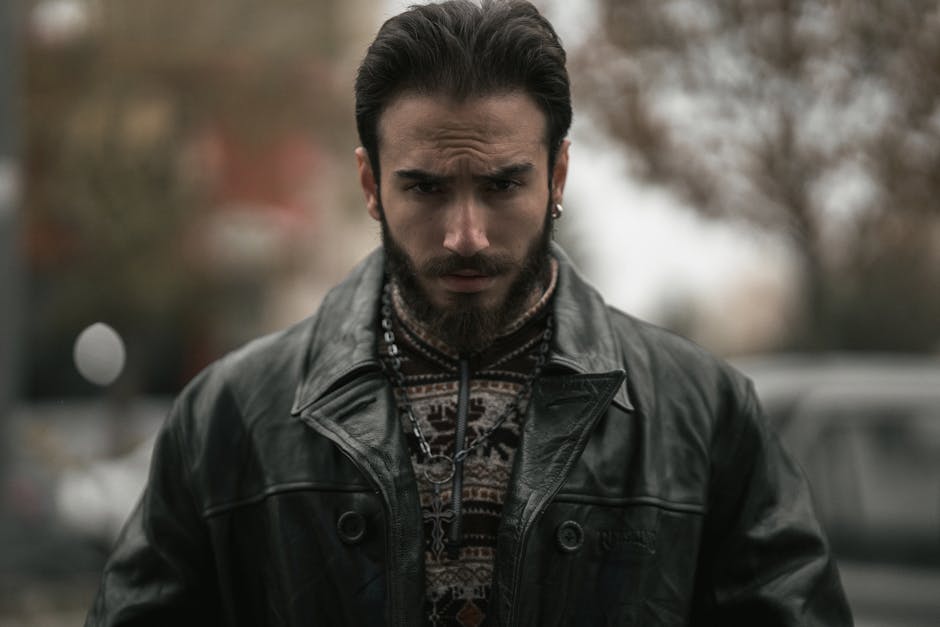
Leather jacket alterations are expensive and often structurally limited. If the shoulder seam drops past your actual shoulder joint, no alteration saves it — you’d essentially be rebuilding the jacket. Buy the jacket that fits perfectly across the shoulders even if the body feels slightly snug; the leather breaks in and conforms to your torso over time. A dropped shoulder never recovers.
Three Outfit Combinations That Actually Get Used
These aren’t mood-board fantasies assembled for an editorial shoot. These are combinations that work in real life — commuting, weekends, casual evenings — because the logic behind them is simple enough to repeat without thinking.
-
Biker jacket + white Oxford shirt + dark jeans + white leather sneakers
The contrast between the jacket’s rigidity and the shirt’s softness creates the visual interest. Tuck the shirt in. Use slim or straight-cut jeans — not skinny, not wide-leg. White sneakers prevent the combination from tipping into costume territory. Add a lightweight merino underneath when it gets cold and the outfit carries across three seasons.
-
Leather bomber + crew neck sweater + grey wool trousers + loafers
The bomber replaces the blazer layer in smart-casual contexts. A crew neck adds warmth and structure without the formality of a button-down. Grey trousers elevate the bottom half enough that the leather on top reads as intentional rather than casual. Loafers complete the transition away from weekend territory. This works for dinner, a gallery opening, or a relaxed office environment where a suit would be overkill.
-
Racer jacket + plain tee + straight-leg jeans + Chelsea boots
The cafe racer’s minimal design means the outfit’s character lives in the other pieces. A fitted plain white or black tee is enough — no graphics, no logos competing with the jacket’s clean lines. Straight-leg denim balances the jacket’s slim silhouette. Chelsea boots ground the look without demanding attention. This is the combination for when you want the leather present but not the point.
The consistent logic: leather jackets carry visual weight. Everything else should be simple, well-fitting basics. The moment you add a graphic tee, statement sneakers, and heavy chain hardware simultaneously, you’re styling a costume, not an outfit.
The Four Mistakes That Kill a Leather Jacket Purchase

Most negative reviews of leather jackets — “it fell apart after two years,” “it never felt right,” “I barely wore it” — trace back to one of these four decisions made at the point of purchase.
Buying One Size Up Because the Leather Will Stretch
Leather does break in. But breaking in means softening and conforming to your body — not becoming larger in circumference. A jacket that fits loosely at purchase remains loose. The shoulders will droop. The waist will bag. The collar won’t sit flat. The correct size is the one that feels snug at the shoulders and slightly tight across the chest. After 20–30 wears, the leather settles into your shape and the fit becomes natural. The only exception: if you genuinely cannot close the zipper without force, size up. Short of that, buy what fits the shoulders.
Not Understanding Leather Grades Before You Buy
“Genuine leather” is a legally accurate and practically useless phrase. It covers everything from premium full-grain hide to compressed leather scraps glued together with polyurethane. The tag tells you nothing about durability. What actually matters:
- Full-grain leather: The outermost hide layer, unaltered. Most durable grade. Develops patina over years. Found in Schott NYC, Acne Studios, and higher-end production runs.
- Top-grain leather: Sanded and buffed to remove surface imperfections. Consistent, smooth finish but lower longevity than full-grain. Common in the $200–$500 range from brands like AllSaints.
- Bonded or split leather: Scraps fused with adhesive and coated to mimic real leather. Starts peeling at seams within two to three years of regular wear. Avoid regardless of how convincing it looks on the rail.
If a retailer can’t tell you which grade they’re selling, that’s your answer. Brands that use full-grain leather specify it — because it’s a selling point.
Ignoring the Lining Until It’s Too Late
A cheap nylon lining creates static, clings to knit sweaters, and wears through at the cuffs within a year of daily use. Better jackets use satin, polyester twill, or quilted interior linings that slide cleanly over layers and add useful insulation. When trying a jacket on, put it over a light merino or cotton knit. If the lining catches or drags, you’ll experience that friction every single time you put the jacket on. Over two years of winter wear, that’s hundreds of frustrating interactions with a jacket you paid $400 for.
Choosing the Wrong Leather Weight for Your Climate
Full-grain cowhide is heavy, stiff, and largely impermeable. It’s built for cold weather and genuinely keeps wind out. If you live somewhere that rarely drops below 45°F, you’re carrying significant weight for marginal warmth benefit. Lambskin — like that used in the Acne Studios Velocite jacket ($1,200–$1,800) — is softer, lighter, and drapes far more elegantly. The tradeoff: lambskin marks and scuffs more easily than cowhide and won’t develop the same rugged patina over time. Choose based on your actual climate and how careful you are with clothing, not based on which material sounds tougher.
What Men’s Leather Jackets Actually Cost — Brand by Brand
The market runs from $80 to $5,000+. Most of that range is either too cheap to trust or priced above performance. Here’s where the real value sits:
| Brand | Jacket | Price | Leather Grade | Verdict |
|---|---|---|---|---|
| Schott NYC | Perfecto 618 | $450–$600 | Full-grain cowhide | Best lifetime biker jacket — buy once, keep forever |
| AllSaints | Conroy Leather Jacket | $350–$450 | Top-grain lamb/cow | Best versatile bomber at this price point |
| A.P.C. | Leather Blouson | $700–$900 | Full-grain lamb | Best minimalist option — clean, understated silhouette |
| Acne Studios | Velocite Jacket | $1,200–$1,800 | Full-grain lamb | Premium feel, but lambskin durability tradeoffs apply |
| Wilson’s Leather | Various moto / bomber | $150–$300 | Top-grain | Decent entry-level — not a long-term buy |
| Levi’s | Faux Leather Trucker | $100–$150 | PU / faux | Honest about being faux — useful for testing silhouettes |
The $350–$600 Range Is Where Most Men Should Shop
This is the honest sweet spot. You get genuine leather construction (top-grain minimum), a functional lining, hardware that doesn’t oxidize in one season, and brand quality control that the budget tier can’t match. Schott NYC and AllSaints both operate in this range with decades of consistent production behind them. For most men buying their first serious leather jacket, this is the target.
The Over-$800 Question
Acne Studios and A.P.C. make genuinely excellent jackets. But for most men, the performance gap over a Schott at $550 is marginal. Full-grain cowhide at $550 outlasts full-grain lambskin at $1,400 on pure durability — cowhide is structurally tougher. The premium buys softer leather, a more refined silhouette, and brand prestige. If those things matter to you and your budget supports it, buy it without guilt. If durability and longevity are the priority, the Schott is the better decision.
Sizing Questions That Keep Coming Up
Should the jacket feel tight when new?
Yes — tighter than you’d expect from any other outerwear. You should be able to close the zipper and move your arms naturally, but fitting a heavy knit comfortably underneath should feel like a stretch. That snugness disappears over 30–50 wears as the leather softens. A jacket that feels perfectly relaxed at purchase will feel sloppy within a year of regular use.
Where should the sleeve end?
At the wrist bone, with roughly half an inch of shirt or sweater cuff visible when your arms hang at your sides. Leather sleeve alterations are possible — a cobbler or leather specialist can shorten them for $50–$100 — but the process risks changing the jacket’s overall proportion. Measuring correctly at purchase costs nothing. Getting it wrong costs $75 and a trip to a specialist.
Does the zipper placement matter?
On biker jackets, yes. The asymmetric diagonal zip on the Schott Perfecto isn’t decorative — it’s functional, designed to avoid sternum pressure when crouched over a motorcycle. For everyday wear off a bike, center-zip biker jackets (common in AllSaints’ range) read cleaner and pair more easily with varied outfits. The diagonal zip is more traditional; the center zip is more versatile. Neither is wrong.
When a Different Jacket Is the Smarter Buy
A leather jacket is not the universal outerwear solution it’s sometimes marketed as. For men who don’t yet own a quality wool overcoat or a reliable mid-layer, the leather jacket should wait. It’s the third or fourth outerwear piece in a complete wardrobe — not the foundation.
If your budget is under $200, skip leather entirely. Buy an Alpha Industries MA-1 nylon bomber at $130–$150 instead. The MA-1 is a legitimate design classic built for function. It doesn’t fake quality it doesn’t have. A well-made nylon bomber beats a poorly made leather jacket on every practical metric except material prestige.
If you dress primarily in business-casual or smart-casual environments, the standard biker or bomber may not integrate cleanly into your daily rotation. A leather blazer cut — Club Monaco makes a structured version around $600–$700 — bridges the gap between outerwear and tailoring in a way that a moto jacket cannot. It pairs with trousers and dressed-up chinos without the casual gravitational pull that biker jackets inherently create.
For men in mild climates — anywhere that averages above 55°F through fall and winter — heavy cowhide may genuinely be impractical. A suede jacket from Nudie Jeans ($250–$350) offers similar visual weight with better breathability and a softer hand. The leather jacket earns its place in a wardrobe built around actual cold-weather use. Know what your climate requires before committing to the material.