Your 8-year-old Labrador has been sluggish for three months. The vet runs bloodwork, tells you everything is within normal range, and circles “immune support” on a printed handout. You go home and start researching. Somewhere after midnight, you end up reading forum posts where people swear turkey tail mushrooms extended their dog’s life after a cancer diagnosis. Someone else credits reishi for reversing their shepherd’s arthritis. And right below that: a photo of a dog hospitalized after eating a mushroom found in the backyard.
This is a genuinely confusing space. Medicinal mushrooms and toxic mushrooms share a category name, and the supplement market is full of products making claims that range from cautiously research-backed to completely unsubstantiated. After digging through the studies, comparing actual products, and reviewing integrative veterinary guidance, here is what the picture actually looks like.
Why Dog Owners Are Adding Mushrooms to Their Pets’ Bowls
The interest in functional mushrooms for dogs follows the same arc as every major human wellness trend — once something gains real traction in the human supplement market, pet versions emerge within a few years. But unlike some wellness fads, this one has a thread of genuine science running through it.
The Research That Started It All
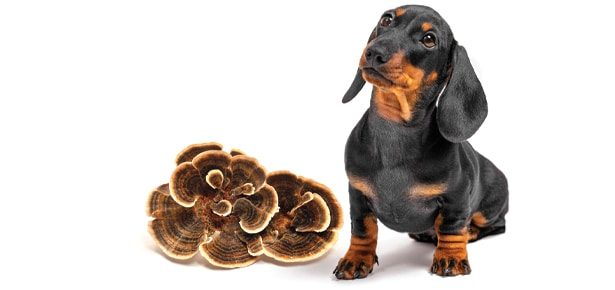
The most referenced study in this space involved turkey tail mushrooms (Trametes versicolor) and dogs diagnosed with hemangiosarcoma — a fast-moving, almost universally fatal cancer of the blood vessel lining. Researchers at the University of Pennsylvania School of Veterinary Medicine found that high-dose turkey tail extract extended median survival time in dogs with splenic hemangiosarcoma from 86 days to 199 days compared to historical controls.
That is not a cure. But doubling survival time with a food-derived compound in a disease where conventional options are severely limited got the attention of veterinary oncologists. The study used a compound called PSK (Polysaccharide-K), derived from turkey tail’s beta-glucan fraction. PSK has decades of research in human oncology, where it has been used as an adjunct cancer therapy in Japan since the 1980s.
This is the strongest evidence in veterinary mushroom research. Everything else — lion’s mane for cognitive function, reishi for liver support, cordyceps for energy — rests on human studies, in vitro data, or clinical observation rather than controlled dog-specific trials. That matters when setting expectations.
What Functional Mushrooms Actually Do Inside a Dog’s Body
Three mechanisms do the real work:
- Beta-glucans are complex polysaccharides found in fungal cell walls that modulate the immune system. They do not simply boost immunity — they help regulate it, activating natural killer cells and macrophages while also calming overactive immune responses. This dual action matters particularly for dogs with allergies or autoimmune conditions.
- Adaptogenic compounds in reishi and cordyceps help regulate the body’s stress response, which has downstream effects on chronic inflammation and cortisol-related immune suppression in dogs that live in high-stress environments or have anxiety disorders.
- Prebiotic fiber in functional mushrooms selectively feeds beneficial gut bacteria — Bifidobacterium and Lactobacillus species in particular — which drives immune function through the gut-immune axis. This is underappreciated and often more impactful than the direct supplement effect.
The dogs who see the clearest benefit are senior dogs, dogs recovering from illness or surgery, and dogs with chronic inflammatory conditions. That is where the biological mechanisms have the most room to make a measurable difference.
Safe Medicinal Mushrooms vs. Toxic Species: What Every Owner Needs to Know
Most articles about mushrooms for dogs list the beneficial ones without adequately covering the dangerous ones. That gap costs lives. Wild mushrooms are off the table regardless of identification confidence — experienced foragers misidentify deadly species regularly, and dogs that ingest Amanita phalloides (Death Cap) can show only mild initial symptoms while liver failure develops silently over three to five days. The ASPCA Animal Poison Control Center receives hundreds of mushroom ingestion calls every year.
The only safe source for mushrooms your dog will consume is a commercial supplement made from verified, food-safe species — or store-bought culinary mushrooms like shiitake, cooked before serving.
| Mushroom | Safe for Dogs? | Primary Benefit | Best Form | Evidence Level |
|---|---|---|---|---|
| Turkey Tail (Trametes versicolor) | Yes | Immune modulation, cancer adjunct | Powder, capsule | Strong — UPenn veterinary trial |
| Reishi (Ganoderma lucidum) | Yes | Anti-inflammatory, liver support | Powder, extract | Moderate — human data plus vet observation |
| Lion’s Mane (Hericium erinaceus) | Yes | Cognitive support, nerve health | Powder, soft chew | Moderate — NGF synthesis research |
| Shiitake (Lentinula edodes) | Yes (cooked only) | Immune support, liver enzymes | Cooked food, dried powder | Moderate |
| Maitake (Grifola frondosa) | Yes | Blood sugar regulation, immune | Powder, capsule | Moderate |
| Chaga (Inonotus obliquus) | Use caution | Antioxidant | Powder | Limited — high oxalate content is a concern |
| Death Cap (Amanita phalloides) | FATAL | — | Wild only | — |
| Fly Agaric (Amanita muscaria) | TOXIC — neurological | — | Wild only | — |
| Autumn Skullcap (Galerina marginata) | FATAL | — | Wild only | — |
Two caveats on the safe list. Chaga has high oxalate content, which can accelerate kidney stone formation in dogs with a history of calcium oxalate urolithiasis — skip it for those dogs entirely. Raw shiitake contains lentinan compounds that can trigger flagellate dermatitis, a distinctive streaky skin rash, in sensitive individuals. Cooked or commercially dried shiitake powder does not carry this risk.
The Health Claims With Real Evidence Behind Them
Ranked by how much supporting research actually exists for dogs:
- Immune modulation has the strongest evidence. Beta-glucans from turkey tail, reishi, and maitake activate NK cells and macrophages while also helping regulate overactive immune responses. Particularly relevant for dogs on long-term corticosteroids, which suppress immunity as a direct side effect of treatment.
- Cancer adjunct support is backed by the UPenn turkey tail study. Oncologists who recommend it are explicit: this is not a replacement for surgery or chemotherapy. It is used alongside conventional treatment to potentially extend time and quality of life in a disease where every additional month matters.
- Cognitive support in senior dogs is where lion’s mane stands apart from the rest. It stimulates nerve growth factor (NGF) synthesis, a protein critical to the growth and maintenance of neurons. In dogs showing signs of canine cognitive dysfunction — disorientation, disrupted sleep, loss of housetraining — lion’s mane has one of the few biologically plausible mechanisms among available supplements. The human equivalent research on NGF and neurodegeneration is well-established.
- Liver enzyme support from reishi has clinical backing from integrative vets who prescribe it alongside long-term NSAID therapy. Chronic NSAID use raises liver enzyme levels as a known side effect; reishi’s hepatoprotective triterpene compounds may offer a partial buffer. This does not replace regular bloodwork monitoring.
- Gut microbiome health from mushroom prebiotic fiber is underappreciated across the entire category. The selective effect on Bifidobacterium populations is documented in gut microbiome research. For dogs recovering from antibiotic courses, or those with chronic loose stool or IBD, this prebiotic benefit may matter as much as any direct immune effect.
- Athletic performance and respiratory support is where cordyceps gets marketed to working dog and agility competition owners. The evidence is thinnest here — rodent and human studies on mitochondrial ATP production exist, but nothing dog-specific at clinically relevant doses. Not harmful to try, but do not expect measurable improvements in your dog’s agility times based on current data.
When Mushroom Supplements Won’t Help Your Dog
Active infections, acute illness, and undiagnosed conditions all require a vet, not a supplement. Mushrooms work slowly — six to eight weeks minimum before any effect is measurable — and they have no meaningful antibacterial or antiviral activity at supplement doses. Dogs with bleeding disorders should avoid reishi specifically; its mild anticoagulant properties can compound clotting problems in an already compromised system.
If your dog is actively getting worse, stop researching supplements and call your vet today.
The Best Mushroom Supplements for Dogs Right Now
Real Mushrooms “5 Defenders Organic Mushroom Powder for Dogs” ($34.95 for 60g) is the clear pick for most dog owners. The reason is sourcing. It uses whole fruiting bodies rather than mycelium grown on grain — a distinction that matters enormously in this market. Mycelium-on-grain products, which dominate the cheap end of the shelf, contain significant quantities of starch from the grain substrate. That starch gets counted toward the beta-glucan content on the label. You are paying for mushroom potency and receiving diluted filler. Real Mushrooms publishes third-party beta-glucan test results for each batch, typically showing 20–30% beta-glucan content. The 5 Defenders blend includes turkey tail, reishi, shiitake, maitake, and chaga in doses calculated for dogs by body weight. For a dog already dealing with a health condition, this is where the money goes.
For dogs who refuse powder mixed into food — and a meaningful percentage do — Zesty Paws Mushroom Bites ($25.99 for 90 chews) solve the compliance problem. The formula includes turkey tail and reishi. Beta-glucan content per serving is lower than Real Mushrooms powder, but a consistent lower dose beats an inconsistent higher one. These are also the most practical option for travel or daily routines where measuring powder is inconvenient.
Host Defense MyCommunity ($32.95 for 60 capsules) from mycologist Paul Stamets’ company is the gold standard in the human mushroom supplement market, and many dog owners open capsules and mix the powder into food. It contains 17 mushroom species using certified organic fruiting bodies with hot water extraction. Dosing adjustment for dogs is straightforward: roughly one-quarter capsule for dogs under 25 lbs, one-half capsule for 25–60 lbs, and one full capsule for dogs over 60 lbs, given once daily. The product is not marketed specifically for pets, but the ingredient quality is among the highest available at this price point.
One product type to skip entirely: anything that does not list beta-glucan content anywhere on the label or the company’s website. No beta-glucan testing means no accountability for potency. You could be buying expensive grain starch with a mushroom photo on the bag.
How to Add Mushrooms to Your Dog’s Diet Without Making Mistakes
How much should I give my dog?
Most reputable manufacturers recommend 500–1000mg per 20 pounds of body weight, once daily. Start at the lower end for the first two weeks. Some dogs experience loose stool initially as the gut microbiome adjusts — this typically resolves within seven to ten days. If it does not, reduce the dose by half and increase more gradually over the following month.
Should I talk to my vet before starting?
Yes, and not just as a formality. Reishi has mild anticoagulant effects that can interact with blood thinners like warfarin. Mushroom beta-glucans modulate immune responses in ways that may theoretically interact with immunosuppressant drugs like cyclosporine, used in dogs with immune-mediated conditions. If your dog is on any long-term medication, a five-minute vet conversation eliminates the uncertainty. Most integrative and holistic veterinarians are now well-versed in medicinal mushrooms and can offer guidance based on your dog’s specific health profile.
What does a quality supplement label actually look like?
Four things to verify before purchasing: (1) “Fruiting body” listed as the source — not “mycelium” or “mycelial biomass.” (2) A stated beta-glucan percentage, with quality products in the 20–40% range. (3) No fillers like maltodextrin or rice flour appearing high in the ingredient list. (4) Third-party testing verification or USDA Organic certification.
The extraction method matters as much as the source. Hot water extraction is the standard process for making beta-glucans bioavailable — they are locked inside chitin cell walls and pass through the gut largely unabsorbed if the extraction step is skipped. A raw dried mushroom powder without hot water extraction is significantly less effective than an extracted product at the same stated dose.
How long before you see a difference?
For general wellness in a healthy dog, changes tend to be subtle — possibly a shinier coat, more consistent digestion, steadier energy levels across the day. You may not notice anything dramatic, which does not mean nothing is happening at a cellular level. For dogs with specific conditions like cognitive decline or post-surgical immune recovery, plan for eight weeks minimum at consistent daily dosing before you evaluate whether it is working.
Back to that Labrador from the beginning. After ten weeks on Real Mushrooms 5 Defenders mixed into his morning kibble, his owner described his energy as back to roughly 70% of what it used to be. Follow-up bloodwork showed modestly improved liver enzymes. The vet’s response was cautiously positive and open to continuing. Not a dramatic transformation — but real enough to keep going, which is exactly the realistic outcome the research supports.