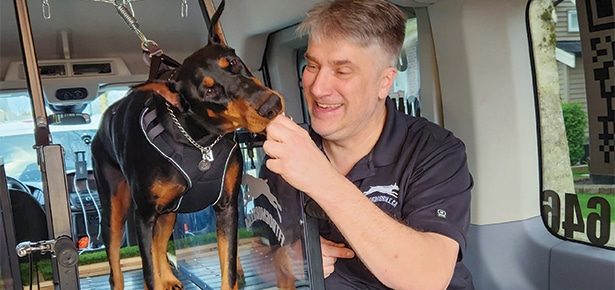
You’ve probably seen it a hundred times — a sleek Doberman with upright triangular ears and a stub where a tail should be. Or a Boxer with that sculpted, compact look. These aren’t accidents of breeding. They’re the result of surgical procedures performed on puppies in the first weeks of life, usually before you ever meet the dog.
Most people assume there’s a medical reason. There isn’t. Not for the average pet dog.
But the full story is messier than either side usually admits. The history, the kennel club politics, and the actual research on pain and canine communication — all of it matters if you want to understand why these practices persist and what’s slowly starting to shift.
What These Procedures Actually Involve
These are two distinct surgeries, often grouped together because both are performed on healthy puppies for cosmetic reasons. The methods, timing, and recovery are quite different.
Tail Docking: What Happens and When
Tail docking removes part of a dog’s tail. It’s typically done at 3–5 days old — before most buyers ever see the puppy. There are two methods. The first uses a rubber band or tight ligature around the tail to cut off circulation; the tail falls off within days. The second is surgical amputation with scissors or a scalpel.
Neither method is routinely performed with anesthesia at that age. The historical justification is that neonatal puppies don’t feel pain the way older dogs do. The American Veterinary Medical Association (AVMA) formally rejected this in its 2026 policy update, stating that pain pathways are functional in neonatal dogs and that a puppy’s muted behavioral response reflects an undeveloped behavioral toolkit — not an absence of pain experience.
The specific dock length varies by breed. An Australian Shepherd gets one or two vertebrae removed. A Cocker Spaniel loses about half the tail. A Doberman Pinscher gets a very short dock. These lengths are dictated by American Kennel Club (AKC) breed standards, which show dogs must meet to compete in conformation events.
Ear Cropping: Timeline and What It Actually Requires
Ear cropping happens later — typically between 7 and 12 weeks — because it requires general anesthesia. A veterinarian removes part of the outer ear flap (the pinna) and sutures the edges. Then the posting begins.
For ears to stand upright as intended, they must be taped and supported with foam or hard posts for months. A Great Dane with a show-style crop may need posting for 4–6 months. The posts must be changed regularly, monitored for infection, and adjusted as the ears heal. This is not a one-day procedure — it’s a months-long commitment that many buyers discover only after the surgery is done.
What Can Go Wrong
Tail docking complications include infection, incomplete healing, and neuroma formation — a painful bundle of nerve tissue that can develop at the amputation site. Neuromas are underdiagnosed in docked dogs because owners rarely know to look for them. Signs include sensitivity near the dock, flinching when touched near the tail, or unexplained behavioral changes.
Ear cropping complications range from infection and scarring to complete failure of the ears to stand, sometimes requiring corrective procedures. When cropping is performed by unlicensed individuals — which happens more than the industry acknowledges — outcomes can be severe. The Royal College of Veterinary Surgeons (RCVS) has described both procedures as convenience surgeries with no therapeutic justification for healthy animals.
Why These Practices Exist: The Real History
The original reasons were practical, not aesthetic. Understanding the history explains how these practices got embedded in breed standards and why they’ve proven so resistant to reform.
- Working dog injury prevention. Hunting dogs running through dense brush could catch and tear a long tail on undergrowth. Dogs used in fighting (when legal) had ears cropped to reduce grip points for opponents. Herding dogs were docked to minimize field injuries. These were real functional arguments — for specific dogs doing specific jobs in specific conditions.
- Tax evasion in 18th-century England. England taxed working dogs but exempted so-called cur dogs. Docking a tail became unofficial proof that a dog was a working animal and exempt from taxation. The practice became so routine it calcified into visual breed expectations.
- The infection prevention myth. The belief that floppy ears caused chronic ear infections drove ear cropping for decades. This has been studied thoroughly and found to be false. Ear infections in dogs are caused by allergies, moisture accumulation, and ear anatomy — not ear shape. Cropping provides no documented infection protection.
- Breed identification before microchips. Physical markers — tail length, ear shape, coat — were how breeds and bloodlines were identified. Microchipping, DNA testing, and tattooing have replaced all of that.
- Show ring aesthetics locking in the look. Once a standard was written around the cropped and docked appearance, it became self-reinforcing. Judges rewarded it. Breeders conformed. Pet buyers who’d only ever seen cropped Dobermans assumed the look was natural to the breed. The aesthetic became the norm, and the norm became an expectation enforced by competition rules.
What Veterinary Research Actually Confirms
The scientific consensus on this topic isn’t ambiguous. The debate exists in breeding communities and kennel club boardrooms — not in peer-reviewed literature.
Do puppies feel pain during tail docking?
Yes. Research on neonatal pain in mammals — including studies on piglets, rat pups, and canine neonates — consistently shows that pain pathways are active and functional at birth. A 3-day-old puppy’s behavioral response during docking (crying, withdrawal, elevated cortisol levels) confirms pain processing is occurring, even if it looks different from an adult dog’s response. The AVMA’s policy paper makes this point without equivocation.
Does ear cropping actually prevent ear infections?
No. The ASPCA states that ear cropping provides no documented health benefit. Multiple comparative studies have found no meaningful difference in ear infection rates between cropped and uncropped dogs of the same breeds. Breeds notorious for ear infections — Cocker Spaniels, Basset Hounds — have floppy ears, but so do Labrador Retrievers and Beagles, which have much lower infection rates. The determining factors are ear canal anatomy, allergy status, and moisture exposure, not whether the outer flap stands up or droops.
Does tail loss affect how dogs communicate?
Significantly. Tail position, movement speed, and direction are among the most information-dense signals in canine body language. A wagging tail held low signals something fundamentally different from a wagging tail held high. Research from the University of Victoria demonstrated that dogs with docked tails were approached more cautiously and misread more often by other dogs. Over a lifetime, this affects every social interaction a dog has — at the dog park, in multi-dog households, and with unfamiliar dogs on walks.
Where These Procedures Are Banned
| Country / Region | Tail Docking | Ear Cropping | Year / Notes |
|---|---|---|---|
| United Kingdom | Banned | Banned | 2006 — Animal Welfare Act; limited working dog docking exemption exists |
| Australia | Banned | Banned | All states; RSPCA actively prosecutes violations |
| Germany | Banned | Banned | 1998 — among the earliest national bans in Europe |
| Netherlands | Banned | Banned | 2001; import of visibly cropped/docked show dogs restricted |
| Brazil | Banned | Banned | 2019 federal animal cruelty law update covers both procedures |
| Canada | Varies by province | Banned in several provinces | Ontario, PEI, Nova Scotia, Saskatchewan have full or partial bans |
| South Africa | Banned | Banned | 2008; SPCAs enforce actively under animal protection statutes |
| United States | Legal — all states | Legal — all states | No federal ban; Maryland introduced legislation in 2026, did not pass |
Over 40 countries have now banned one or both procedures. The United States stands nearly alone among wealthy, dog-owning nations in its permissive stance. The AKC’s continued support puts it at odds with every major veterinary body in the world, including the World Small Animal Veterinary Association.
The Part Nobody Says Out Loud
The reason this debate keeps going is structural: it happens to animals that can’t testify, to puppies too young to fit our visual template for suffering, behind closed doors before the buyer ever arrives. The puppy comes already docked, already cropped, and the new owner never has to think about what happened in week one.
Why AKC Breed Standards Are the Real Obstacle
The AKC’s breed standards are the primary reason cosmetic docking and cropping remain routine in the United States — and the organization has shown little urgency about changing them.
Dozens of AKC-recognized breeds require or strongly prefer cropped ears and docked tails to compete in conformation shows. Doberman Pinschers, Boxers, Great Danes, Giant Schnauzers, and Miniature Pinschers all have standards written around the surgically altered look. Breeders who show are economically motivated to conform. Pet buyers who purchase from show lines get docked and cropped puppies as the default, often without explanation of what occurred or the option to choose otherwise.
Compare this to the Fédération Cynologique Internationale (FCI), which governs dog shows across Europe and much of South America. After national bans passed, the FCI updated its standards. Dobermans, Boxers, and Great Danes now compete at the highest international levels with natural ears and full tails. Breeds remained recognizable. The aesthetic adjusted. The argument that a Doberman without cropped ears isn’t really a Doberman has been tested empirically across dozens of countries — and it hasn’t held up.
Change is happening inside U.S. breeding communities, slowly. Segments of the Doberman Pinscher Club of America advocate for natural dogs. Members of the Bouvier des Flandres Club of America actively show natural-eared dogs in competition. These aren’t marginal positions — they reflect where the international community landed years ago. The question for the AKC isn’t whether to change, but how long it takes institutional inertia to give way.
What to Know Before Getting a Breed That’s Typically Docked or Cropped
If you’re considering a Doberman, Boxer, Schnauzer, American Pit Bull Terrier, or any other breed where these procedures are common, here’s what to actually do before you commit.
- Ask before you commit — and ask early. Tell breeders upfront that you want a naturally intact puppy. Because tail docking happens at 3 days old, you need to have this conversation before the litter is born or immediately after. Many breeders will accommodate the request if given enough notice.
- Understand that silence isn’t consent. Any breeder who docks tails at day three before you’ve agreed to take a puppy is making an irreversible decision on your behalf. Know this going in.
- Natural dogs can compete. The AKC’s Canine Partners program and several performance events accept dogs regardless of ear or tail status. If you’re not planning to show in conformation, there is no functional reason to put a puppy through either procedure.
- Ask about neuroma history in the line. If you’re adopting an already-docked dog, tell your vet if the dog seems sensitive near its tail. Neuromas are treatable — but only if they’re identified.
- Reject the infection argument. If a breeder or vet tells you cropping prevents ear infections, that’s not evidence-based. The research doesn’t support it.
| Common Claim | What the Evidence Actually Shows |
|---|---|
| Puppies don’t feel pain during docking | False — AVMA confirmed pain pathways are active at 3–5 days old |
| Cropping prevents ear infections | False — no peer-reviewed evidence supports this claim |
| Docked dogs communicate just as well | False — University of Victoria research shows measurable social signaling loss |
| Breeds lose identity without these procedures | Tested in 40+ countries — breeds remain fully recognizable with natural ears and tails |
| Major vet organizations are neutral on this | False — AVMA, RCVS, and ASPCA all formally oppose cosmetic docking and cropping |