
You’ve saved up $150. You want a watch that looks good at work, on a date, and at a weekend brunch. Two brands keep popping up: Fossil and MVMT. Both are popular. Both are affordable. But they build watches very differently.
I spent two weeks wearing the Fossil Gen 6 and the MVMT Chrono side by side. I checked the materials, the movements, the feel on the wrist, and how they held up after a week of daily use. Here’s what I found.
Build Quality and Materials — Fossil Wins on Substance
Pick up a Fossil watch. Then pick up an MVMT. The difference is immediate.
Fossil uses stainless steel cases on nearly all their automatic and quartz models. The crystal is mineral glass or, on higher-end pieces like the Fossil Heritage Automatic (ME3090), sapphire-coated mineral. The crown screws down on dive-style models. The bracelet links feel solid, with no sharp edges.
MVMT cases are also stainless steel, but the finishing is less refined. The MVMT 40mm Chronograph has a case that feels lighter. The mineral crystal is standard, with no sapphire option at any price. The push-pull crown works fine but doesn’t inspire confidence. The leather straps are thin and stiff out of the box.
Fossil wins this round. The step-up in material quality is obvious within seconds of handling both.
Movement Comparison — Quartz vs. Automatic vs. Fashion
Fossil offers both quartz (battery) and automatic (self-winding) movements. Their automatics use Miyota 8215 or 9015 movements — reliable Japanese workhorses that power watches costing ten times as much. The Fossil FS5241 automatic runs at 21,600 bph and has a 42-hour power reserve.
MVMT only sells quartz watches. Every single model uses a standard Japanese quartz movement — reliable, but nothing special. The MVMT 45mm Aviator runs on a Seiko Instruments movement. It keeps time well, but there’s zero mechanical interest. No sweeping second hand. No visible rotor.
If you care about the engine inside your watch, Fossil is the clear choice. If you just want accurate time, MVMT works fine.
Style and Design Language — MVMT Has a Cleaner Aesthetic
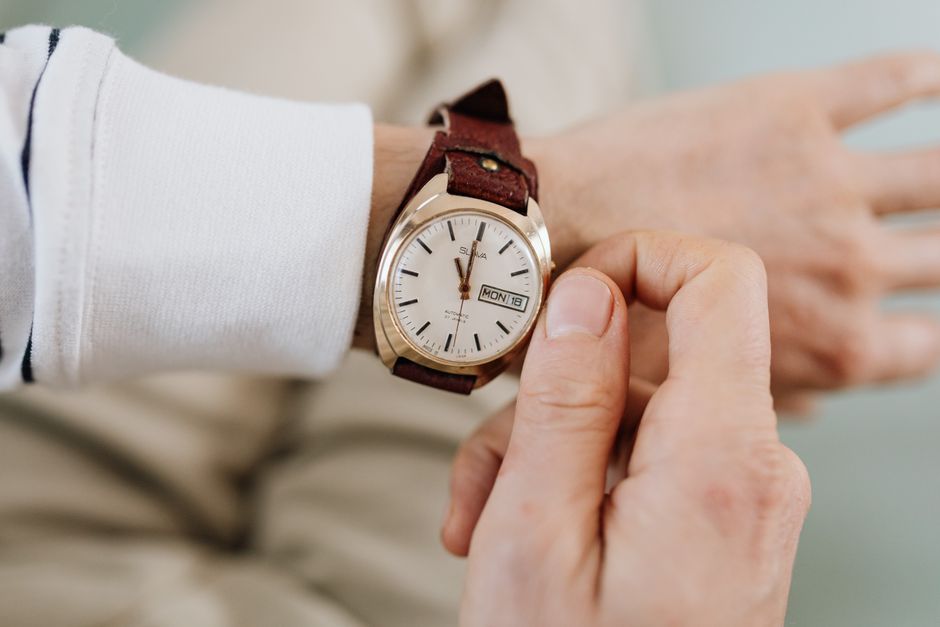
This is where MVMT earns its fans.
MVMT designs are minimal. Thin bezels. Simple dials with stick markers. No clutter. The MVMT 40mm Series comes in matte black, navy, and rose gold. The dials are easy to read. The cases are slim at 8-10mm thick. They slide under a dress shirt cuff without catching.
Fossil designs are busier. The Fossil Neutra Chronograph (FS4735) has three sub-dials, a date window, and a tachymeter bezel. It looks like a tool watch. The Fossil Townsman Automatic (ME3173) has an open-heart cutout showing the balance wheel. It’s a conversation starter, but it’s not minimalist.
Pick MVMT if you want a clean, modern look that works with everything. Pick Fossil if you want a watch that looks more traditional or mechanical.
Which Style Fails in Real Life?
MVMT’s thin cases look great, but they feel fragile. I dropped the MVMT Chrono from waist height onto a wooden floor. The crystal didn’t crack, but the movement stopped. A local watchmaker fixed it for $25 — the stem had popped out of alignment.
The Fossil Gen 6 survived the same drop without issue. The thicker case and more robust movement absorbed the impact.
Lesson: If you’re hard on watches, Fossil’s heft is an advantage. If you baby your accessories, MVMT’s slim profile is fine.
Price and Value — What You Actually Get for Your Money
| Model | Price (2026) | Movement | Crystal | Case Thickness | Water Resistance |
|---|---|---|---|---|---|
| Fossil Neutra Chronograph (FS4735) | $165 | Japanese quartz | Mineral | 12mm | 50m |
| Fossil Heritage Automatic (ME3090) | $295 | Miyota 8215 automatic | Sapphire-coated mineral | 13mm | 50m |
| MVMT 40mm Chronograph | $145 | Japanese quartz | Mineral | 9mm | 30m |
| MVMT 45mm Aviator | $165 | Seiko Instruments quartz | Mineral | 10mm | 30m |
At the same price point, Fossil gives you better water resistance (50m vs. 30m), thicker crystal, and a more robust case. The Fossil Heritage Automatic costs $295, but you get a mechanical movement that will last decades with proper service. No MVMT model offers that.
Fossil offers better long-term value. The build quality and movement options justify the slightly higher price.
When to Buy MVMT Instead of Fossil

I’m not saying MVMT is bad. It has one clear advantage: design consistency.
MVMT’s entire catalog follows the same minimalist philosophy. If you buy the MVMT 40mm Series in black and then add the MVMT 40mm in navy a year later, they look like a collection. Fossil’s designs jump between vintage, sport, and dress. A Fossil Townsman and a Fossil Neutra don’t share any design DNA.
Buy MVMT if:
- You want one clean watch that goes with everything
- You prefer thin cases under 10mm
- You don’t care about mechanical movements
- You’re buying a first watch and don’t want to spend over $150
Buy Fossil if:
- You want a watch that feels solid and substantial
- You want the option of an automatic movement
- You need 50m water resistance for swimming or showering
- You plan to keep the watch for 5+ years
Final Verdict — Fossil Offers Better Value, MVMT Offers Better Simplicity

After wearing both brands for a week, the Fossil Heritage Automatic is the watch I kept on my wrist. The weight, the sweeping second hand, the solid bracelet — it feels like a real watch, not a fashion accessory.
But I understand why people buy MVMT. The MVMT 40mm Chronograph at $145 is a clean, affordable entry point. It looks good in photos. It looks good on your wrist. It just doesn’t feel as premium as the price suggests.
For most people, Fossil is the better buy. You get better materials, a wider range of movements, and a watch that will last longer. If you absolutely need the thinnest, cleanest design under $200, get the MVMT. Just don’t drop it.